My Camera Addiction: A Gear Journey I Don't Regret (Mostly)
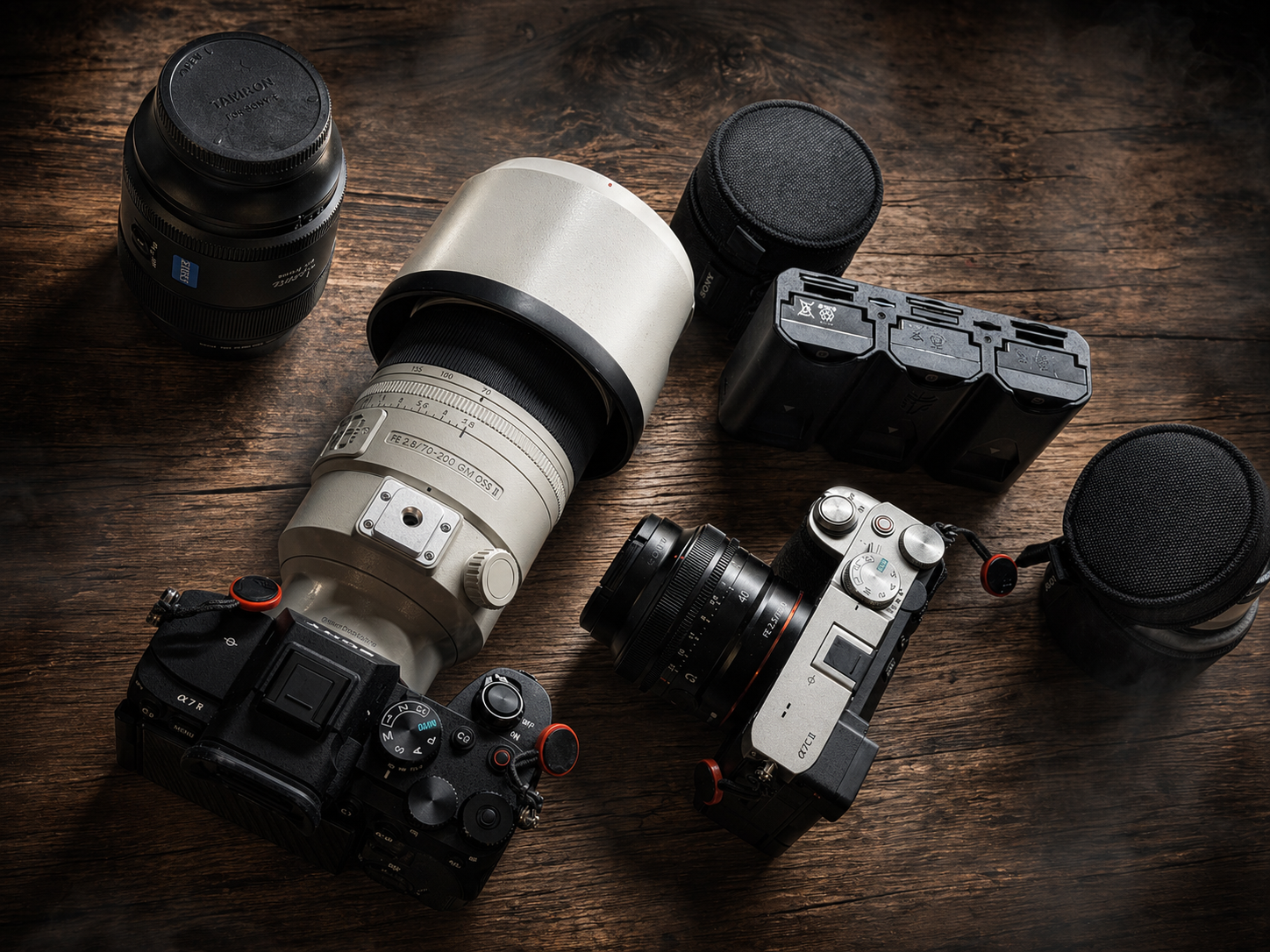
My camera arsenal
Do I have a problem?
No. Definitely not. If I had a problem, I'd know. Right?
OK, maybe I have a slight gear addiction. But hear me out, I've learned things along the way, and if you're anywhere on the camera rabbit hole spectrum, this might save you some money. Or cost you more. Sorry in advance.
It Started With a Sony A7III
The A7III is the camera that made me fall in love with photography. The bokeh, the colors, the feeling of nailing a portrait, it hits different. I was hooked. Naturally, I started investing in lenses. One became two. Two became a full bag. And before I knew it, every trip meant lugging around a backpack full of glass and bodies. Flying to France for Christmas with a backpack heavier than a dead body, running after my delayed plane. More gear also means more lens swaps, which means more missed opportunities.
Until one day, I got tired of it. I looked at my bag and thought: this is supposed to be fun. I should be able to pick up a camera and shoot what I want.
So I did what any rational person would do, I sold everything and went phone-only. Mistake number one.
The Phone Lie
I took iPhone photography classes. Got good results, better results, even. But here's what nobody tells you: when your camera is also your texting machine, your email inbox, and your doomscrolling device, you don't take pictures with it. You just don't. The intention is completely different. I went from shooting everything to shooting nothing. Mistake number two. I needed something in between, something dedicated, but something compact.
The Compact Detour: Sony ZV-1
I reinvested some of the money into a Sony ZV-1. I'd always been impressed by the quality of the RX series, and this one was smaller, lighter, fun to carry around. It was great. Until it wasn't.
Low light? Noise. Portraits? Not enough bokeh. A small sensor without all the AI processing of a phone means phone pictures were better, sometimes by far. It's a fun little camera, but you don't get the control of a full-frame sensor. I was taking more photos, but worse photos. Mistake number three. Time to sit down, step back, and revisit.
Round Two: The Sony A7C II, How to Fall in Love Again
When Sony launched the A7C II, I thought: that's the one. An upgraded A7IV processor in a compact body. Everything I loved about full-frame photography without the bulk that made me quit the first time.
I was right. It's a beautiful camera. I invested initially in the Tamron ecosystem, good sharpness and overall quality for a decent price. But I started getting more serious about soccer photography, and after a fling with the Tamron 150-500 and a few late-night, very pixelated pictures, I invested in the 70-200mm f/2.8 GM. Immediate love, forever. Super sharp, the best lens I've ever had.
Soon my Tamron 24-70, my first love, started sitting in the bag. I picked up a tiny 24mm G and a 40mm G instead. What lenses, small, compact, razor sharp. These became my travel lenses, and the A7C II became my travel body of choice. 40mm full frame, 60mm in APS-C crop. Very good for portraits, two lenses in one. The perfect combo.
The Fuji Temptation
Of course, I also preordered a Fujifilm X100VI. Because why not? Mostly because I ordered it and received it 16 months later, at the peak of the shortage. Mistake number four.
The appeal was obvious: JPEG straight out of camera, film simulations, never open Lightroom again. The dream. Mistake number five.
The issue is twofold. First, finding the right recipes and tuning them is real work, and I consistently get better results shooting RAW and editing later. Second, the menu system is... different, with a steep learning curve. And finally, the Fuji isn't truly pocketable, which was the whole point for me. A Sony A7C II with a short prime gives better results overall and more customization for roughly the same body size. It was too good to be true.
Then Came the Sony A7V
And then I fell in love again.
The A7V is a beast. The speed, the low light capabilities, the autofocus, it's on another level. And once you've experienced 30 frames per second, going back to 8 feels like slow motion. Especially for sports. Especially for soccer.
I shoot my kid's soccer games in the south of Tacoma. Basic stadiums, terrible lights. That's the reality. And the only way to get usable shots in those conditions is high dynamic range and a fast lens. The A7V delivers both. Coupled with the G Master 70-200, it's an unbeatable pair.
The G Master Tax
Here's the uncomfortable truth about lenses: once you try a Sony G Master, there's no going back.
I love my Tamron. It's great glass for a fraction of the price. But the sharpness of my Tamron 28-75 is not equivalent to what I get from my 70-200 G Master. The bokeh isn't quite the same. The speed isn't quite the same, mainly because Sony limits third-party lenses to 15 fps. Close, but you know.
Is a third-party lens 95% of the way there? Absolutely. And if you don't shoot high fps, you can get 100% of it. My Sirui 85mm produces stellar results, yes, I know the autofocus isn't the same, for a fraction of the cost.
So Does Gear Matter?
People who can afford any camera in the world love to say "gear doesn't matter." And they're right, technically. The best camera is the one you have with you.
But also? It matters. Some things are non-negotiable. If you're shooting sports in bad light, dynamic range matters. A fast lens matters. These aren't luxuries, they're the difference between a keeper and a blurry mess.
And at the same time, I still grab my little A7C II with a 40mm prime and get photos I love. So maybe both things are true.
The Point of All This
Here's what I've actually learned: the best setup is the one that makes you want to shoot. The one that lets you keep memories.
I went through the full cycle, heavy gear, no gear, phone only, compact, full frame again. And where I landed is simple: I always have a camera on me now. If I don't, I use my phone and barely take any pictures. That's just who I am.
My current setup is a dual system. Travel: A7C II with the 40mm G. Sports: A7V with the 70-200mm GM. There might be room for a truly pocketable camera, I'm debating whether to trade my Fujifilm X100VI for a Ricoh GR IV. Or maybe Sony will resurrect the RX100 series. One can dream.
Even if it's just 20 or 30 shots from a weekend, those are the ones that matter. The portrait of Camille scoring a goal and celebrating with her friends. Theo opening his Christmas presents. The candid of my wife at her 45th birthday. These pictures are memories, and they matter to me.
So do I have a problem? Maybe. But I'm keeping it.